TWO:The magistrates, now summoned by the Lord Provost to a meeting in the Goldsmiths' Hall, resolved to send a deputation to the prince, desiring that he would cease hostilities till they had had time to decide what they should do. Scarcely had the deputies set out, when news came that the transports, with Cope's army on board, were seen off Dunbar, the wind being unfavourable for making Leith, and that his troops would soon be landed, and in full march for the city. It was now determined to recall the deputation, but that was found to be too late, and General Guest was applied to to return the muskets, bayonets, and cartridge boxes which had been given up to him. Guest very properly regarded men who had thrown up their arms in a panic as unfit to be trusted with them again, and advised that the dragoons should be ordered to unite with Cope's infantry, and advance on the city with all possible speed. About ten o'clock at night the deputation returned, having met the prince at Gray's Mill, only two miles from the city, who gave them a letter to the authorities, declaring that they had a sufficient security in his father's declarations and his own manifesto; and he only gave them till two o'clock in the morning to consider his terms. The deputation returned in the utmost dejection, little deeming that the prince had taken such measures as should render them the means of surrendering the city. But Charles had despatched Lochiel and Murray of Broughton, with eight hundred Camerons, to watch every opportunity of surprising the town, carrying with them a barrel of gunpowder to blow up one of the gates. This detachment had arrived, and hidden themselves in ambush near the Netherbow Port. The deputation passed in with their coach by another gate, and the ambush lay still till the coachman came out at the Netherbow Port to take his carriage and horses to the stables in the suburbs. The ambush rushed upon the gate before it could be closed, secured the sentinels, ran forward to the other gate, and secured its keepers also. When the inhabitants rose in the morning they were astonished to find the city in possession of the Highlanders. On the 17th of September Charles occupied Holyrood. Amidst wild enthusiasm, the Old Pretender was proclaimed as King James VIII. at the Cross, Murray of Broughton's beautiful wife sitting on horseback, with a drawn sword in her right hand, while with her left she distributed white favours to the crowd.
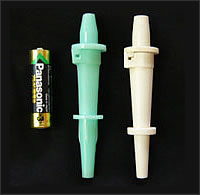
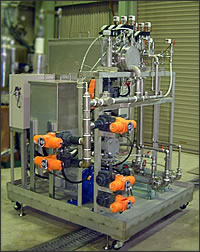
A hydrocyclone (liquid cyclone) injects treatment solution into stationary equipment to perform separation, classification, and concentration, and is an innovative separator with a very simple structure and no drive unit.
Structure of a hydrocyclone (liquid cyclone)
A suspension containing fine particles of several micrometers or more is supplied to a cylindrical container circumferentially at high speed. And as a result it starts to rotate and a centrifugal force is generated. At this time a gravitational acceleration of several tens of thousands of G is generated in the circumferential direction, and thus leading to fast sedimentation and concentration of the fine particles. The separated concentration can be freely selected by changing the supply rate (supply pressure and flow rate) and the flow ratio of the outlet. Our hydrocyclone (liquid cyclone) was designed and manufactured to classify and concentrate fine particles, and so has a small element.
THREE:The treaty between Russia, Prussia, and Austria for the first division of Poland was signed at St. Petersburg on the 5th of August, 1772. The three robber powers now promised to rest satisfied with their booty; to respect the rights and remaining territories of Poland¡ªwords hollow and worthless as they who used them. The invaders divided at this time about one-third of Poland between them. Prussia appropriated the whole of Pomerania, part of Great Poland, the bishopric of Warmia, and the palatinates of Marienburg and Culm; with complete command of the lower part of the Vistula. The whole of this territory did not exceed eight hundred square miles, but it was a territory of vast importance to Prussia, as it united Pomerania with the rest of that kingdom. Russia and Austria acquired immensely more in extent. Russia took nearly the whole of Lithuania, with the vast country between the rivers Dwina and Dniester. Austria secured the country along the left bank of the Vistula from Wieliczka to the confluence of the Vistula and the Viroz. But Russia had Galicia, the palatinate of Belz, and a part of Volhynia. Unsupported by France, England had no course but to acquiesce in the arrangement.
- Equipment costs can be reduced.
- Operating costs can be reduced.
- Maintenance costs can be reduced.
- Any change in raw material and product can be easily addressed.
- Large amounts can be treated in a small area.
- Separation and cleaning are easy because of the simple structure.
- Simplified control
- This equipment can be operated in synchronization with external devices.
- Alarm and interlock mechanism.
THREE:
- Classification and concentration for the manufacture of inorganic powder materials
- Classification of ceramic materials
- Removal of fine particles, including iron powder
- Removal of fine particles from pigments
- Removal of fine organic particles from solvents
- Separation of starch and yeast
- Removal of fine particles from high-temperature strong acid solutions
- Removal of fine particles from low-temperature solutions